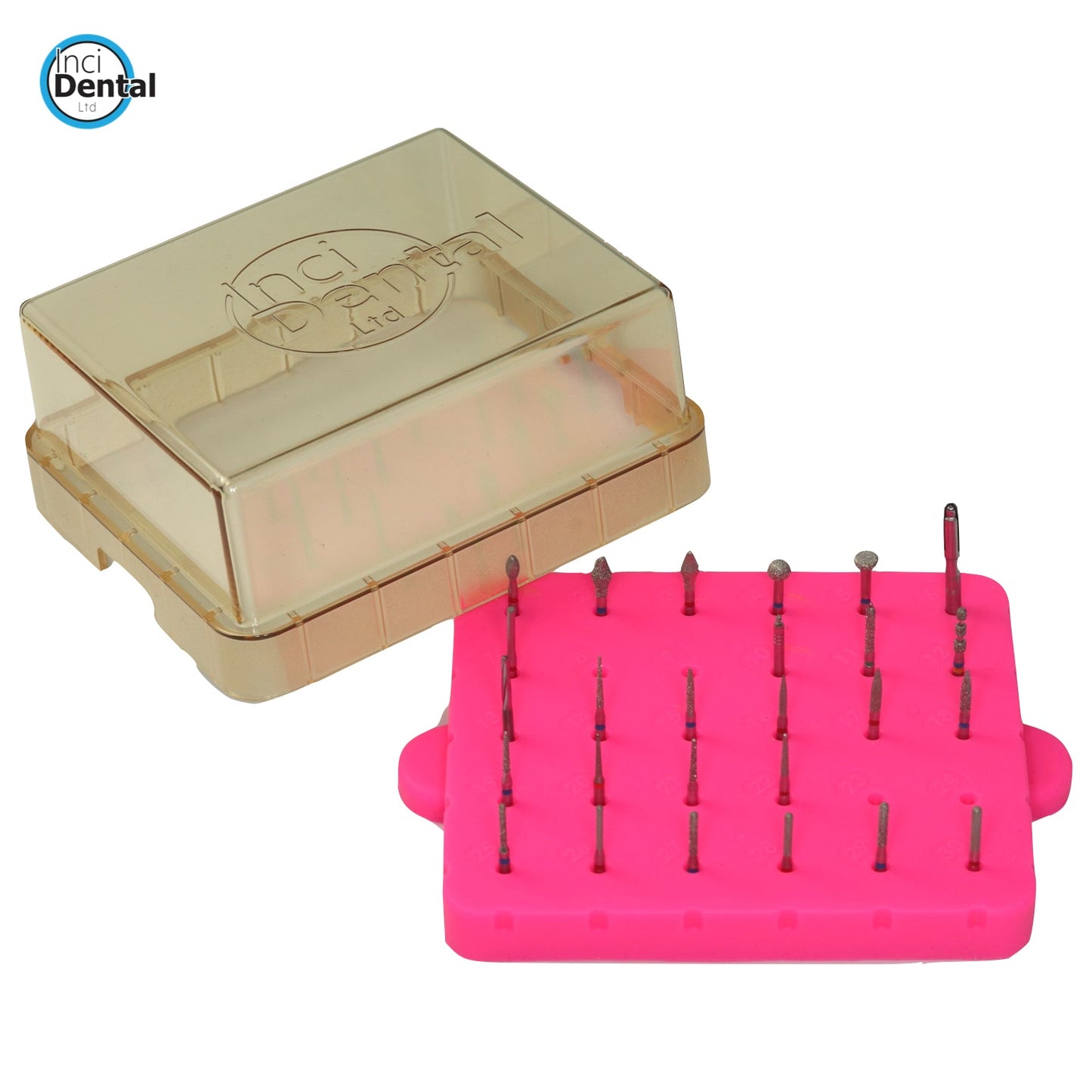
A curated 26-bur kit covering onlays, veneers, conventional crowns, and vertical/BOPT preparations — with custom-specified burs unavailable elsewhere, supplied in the Incidental autoclavable bur stand.
EXPERT OPINION
This kit was built around how we actually prepare teeth, not around what is easy to manufacture. Every bur has a defined role, and the medium/fine pairing philosophy is deliberate: medium grit for initial reduction, fine grit for refinement before impression. Swapping between them at the right stage protects the preparation surface and gives your technician a clean result to work with. Several burs here — the short-shank cylinders (C-27, C-28) and the controlled margin bur (C-11) — were specified to our own dimensions and are not standard Frank Dental catalogue items.
Holds the full kit with spare slots for your own additions. The open-hole design means you can autoclave burs seated in the stand with no decanting required. Numbered positions make reordering individual burs straightforward — download the wall chart below and pin it up.
The kit contains one of each of the following. All burs are available to purchase individually.
The rounded rugby ball profile is the preferred shape for fine finishing of marginal ridges and onlay margins. Use after your medium-grit reduction to clean up margin geometry before impression.
The undulating profile mirrors natural occlusal anatomy for anatomically sympathetic reduction in cuspal-coverage restorations. Medium grit makes this the first-pass occlusal bur.
Identical geometry to C-2 in fine grit. Run after C-2 to unify the occlusal surface and eliminate coarse striations. The optimum speed of 20,000 RPM allows controlled finishing without overheating.
Primary bur for palatal surface reduction on upper incisor crown preparations — prepare half the tooth at a time to gauge reduction accurately. Also useful for occlusal reduction when the Occlusal Shaper cannot achieve the correct angulation.
The flat-sided wheel profile produces effortlessly level incisal reductions during crown and veneer preparations. Also serves as an alternative to the large ball bur for palatal reductions.
For use with the Tor VM polishing disc range at slow-speed contra-angle. Useful chairside for smoothing preparation surfaces and refining provisionals.
Smooth sides, cuts only at the tip. The correct instrument for safely smoothing bumps, lips, or ledges on a finished margin without widening the preparation wall. Also useful for removing deep core material below the margin line.
Produces a precisely uniform 1.5mm occlusal depth cut in a single pass — the minimum reduction typically required for lithium disilicate. Removes reliance on visual estimation.
Produces a controlled 0.4mm rounded shoulder by sinking the bur until the safe-end guide tip contacts the tooth, then sweeping around the preparation. Keep the bur upright — any tilt compromises the uniform margin depth.
Creates controlled 0.4mm facial depth grooves for veneer preparations, ideally through a bisacryl pre-evaluative temporary following the Gurel protocol. The 1.5mm rounded tip also gauges occlusal depth grooves during posterior preparations.
Safe-ended TC bur for pulpal wall removal during endodontic access, and equally effective as a large batt bur for vertical crown preparations where access permits a wider instrument.
The extended diamond portion — longer than most catalogue equivalents — gives better interproximal access for contact point breaking during crown preparations.
Included primarily for BOPT vertical crown preparations, where the thin flame profile gives excellent proximal access for initial cutting passes. Also useful for general proximal margin refinement.
Fine-grit counterpart to C-15. Use after C-15 to eliminate coarse surface texture on proximal walls and margins in BOPT preparations.
Larger diameter flame for facial and lingual surface refinement in BOPT preparations. Fine grit produces a clean, consistent surface texture prior to impression.
Medium-grit counterpart to C-17 for initial facial and lingual reduction in BOPT preparations. The wider body removes tissue efficiently before C-17 refines the result.
Non-end-cutting design safely prepares a knife-edge margin without risk of inadvertent apical extension — essential for edgeless and vertical crown preparations. C-19 (medium) for initial definition, C-20 (fine) to refine.
The wider 1.2mm diameter provides slightly more body to the margin geometry than the 1.0mm pair — useful where a more substantial knife-edge profile is required. Same non-end-cutting safety principle.
Our recommendation for classic crown preparations — the round-ended cylinder naturally produces a rounded shoulder margin. The 1.0mm diameter is particularly valuable for proximal surfaces with limited access.
Custom-specified with a shorter shank than the standard Frank Dental catalogue. Sitting deeper in the handpiece chuck meaningfully improves access for difficult posterior or lingually-positioned preparations. Not available as a standard catalogue item.
The 1.4mm width is indicated for accessible surfaces and where a deeper margin is required — PFM preparations being the classic example. The broader profile removes more material per pass for efficient wider shoulder preparation.
Download the Indirect Bur Kit Wall Chart — for easy organisation and reordering